Cold Exposure · Sensor Science · Garmin · Data Accuracy
Why Your Garmin Heart Rate Goes Wrong in an Ice Bath (And What to Do About It)
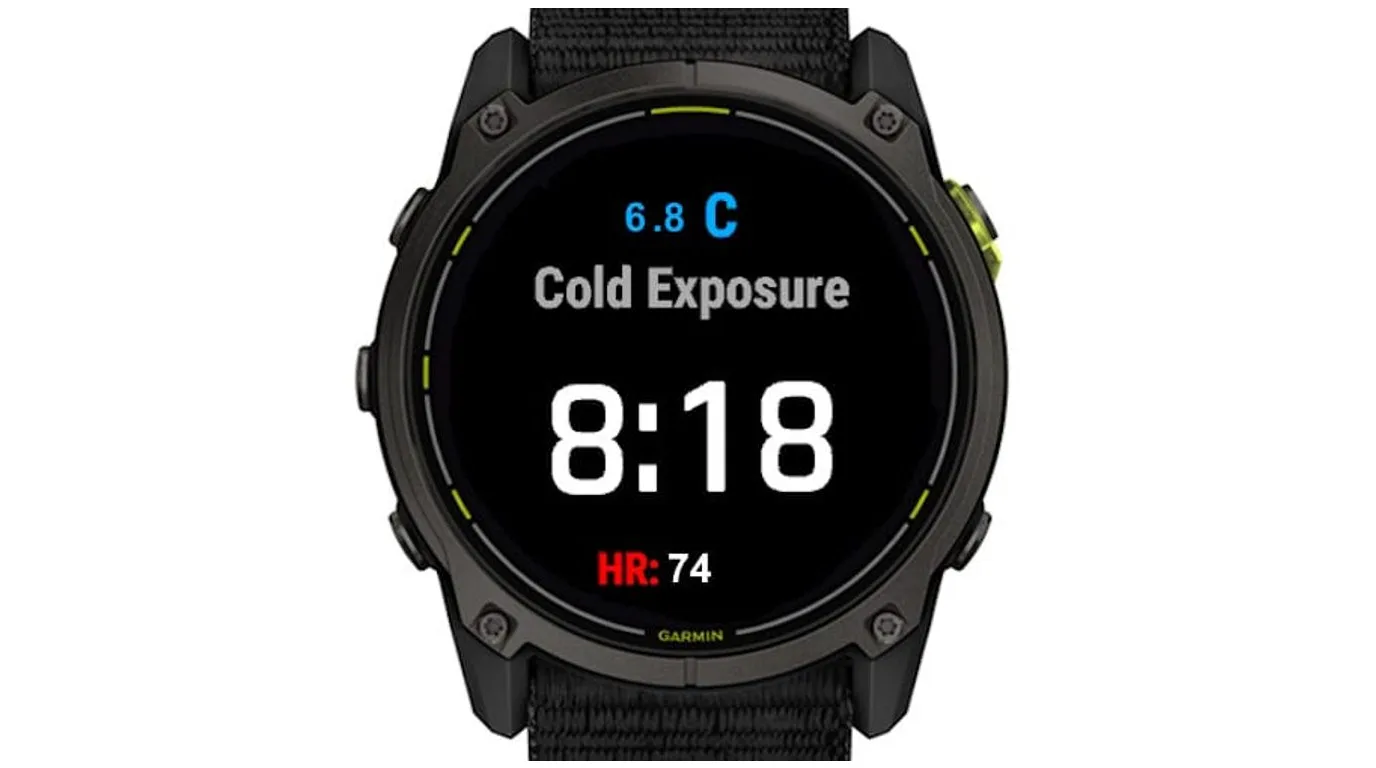
There is a moment familiar to anyone who has taken a Garmin watch into an ice bath. You are thirty seconds in. Your breathing is ragged, your skin is screaming, your heart is unmistakably hammering. You glance at your wrist and the watch calmly informs you that your heart rate is 51 beats per minute.
The instinctive conclusion is that the watch is faulty. It is not. What you are looking at is the predictable consequence of putting an optical sensor against skin that has just deliberately shut off its own blood supply. The physiology that makes the reading wrong is the same physiology that makes cold exposure worth doing — and that connection is worth understanding properly, because it determines what you can and cannot learn from your data.
How Your Watch Measures Heart Rate
Every wrist-based heart rate sensor on the market, Garmin’s Elevate series included, uses a technique called photoplethysmography — PPG. The principle is simple. The watch shines light, usually green, into the skin. Blood absorbs that light. With every heartbeat, a pulse of blood passes through the capillary bed under the sensor, briefly increasing absorption. The photodetector measures the light that bounces back, and the rhythmic dips in returned light become your pulse.
The critical dependency is right there in the mechanism: PPG does not measure the heart. It measures blood volume changes in the capillaries of the wrist, and infers the heart from them. If there is no meaningful blood volume pulsing through your wrist capillaries, there is nothing for the sensor to detect — no matter what your heart is doing.
The core point: optical heart rate is an inference, not a measurement. It reads peripheral blood flow and reconstructs cardiac rhythm from it. Cold-water immersion is specifically designed by evolution to eliminate peripheral blood flow. The two are fundamentally incompatible.
What Cold Water Does to Your Wrist
When skin contacts water below roughly 15°C, the sympathetic nervous system triggers immediate, powerful peripheral vasoconstriction. Blood vessels in the hands, feet, and extremities clamp down, shunting blood inward to protect the core and the vital organs. This is one of the oldest and most effective survival responses in mammalian physiology. Your body is, quite correctly, treating your wrist as expendable.
The magnitude of this shift is dramatic. Skin blood flow in the extremities can fall by the large majority of baseline within the first minute of cold immersion. From the perspective of the PPG sensor, the pulsatile signal it depends on — the alternating-current component of the optical waveform — collapses toward the noise floor. The sensor is not receiving a weak signal. In deep cold, it is frequently receiving almost no usable signal at all.
That last detail is worth pausing on, because honest reporting requires it. The 2026 JMIR validation study did not find the accuracy degradation in cold that its authors hypothesised. But the study tested cold air at 10°C, not cold water immersion — and the authors themselves flag this as a limitation, noting that their temperature range may not have been extreme enough and that extreme or outdoor conditions were not replicated.
The distinction is physiologically substantial. Water conducts heat roughly twenty-five times more efficiently than air. Ten minutes in 10°C air produces a mild peripheral response; ten seconds in 10°C water produces a full cold shock response with maximal vasoconstriction. The published validation literature has not yet tested the condition that cold plunge practitioners actually experience — which is precisely why the practical guidance below matters.
"PPG does not measure your heart. It measures blood in your wrist. Cold-water immersion is the body deliberately removing blood from your wrist. The sensor is not failing — it is accurately reporting an absence."
— On the mechanism of cold-water PPG failureThe Second Problem: Water Itself
Vasoconstriction is the dominant issue, but it is not the only one. Water between the sensor and the skin creates an optical gap, scattering the emitted light and corrupting the returned signal. This is why Garmin’s own documentation on several device families states plainly that wrist-based heart rate is not available while swimming, and directs users to a chest strap or dedicated swim heart rate accessory instead.
There is a useful implication here. Garmin has already acknowledged, in writing, that its optical sensor is not designed to produce reliable heart rate underwater. A cold plunge is underwater immersion with the added complication of maximal vasoconstriction. If wrist HR is unreliable in a warm pool, expecting it to work in a six-degree ice bath is not a reasonable expectation to hold.
What the Bad Data Actually Looks Like
Recognising the failure modes helps you avoid drawing conclusions from artefacts. In cold water, degraded PPG typically produces one of five characteristic patterns.
Implausibly low reading
Signal amplitude has collapsed; the algorithm falls back toward a low estimate or holds a stale value.
Frozen value
No new valid beats detected. The display is showing the last confident reading, not current data.
Wild oscillation
The algorithm is locking onto noise, motion artefact, or harmonics of the true rate.
Cadence lock
Rhythmic muscle tremor produces a periodic optical artefact that mimics a pulse.
No reading at all
The most honest outcome. The watch has correctly determined it has no usable signal.
The fifth pattern deserves a word of appreciation. A watch that shows no reading is behaving correctly — it has assessed its own signal quality and declined to report a number it cannot stand behind. The genuinely misleading outcomes are the first two, because they produce plausible-looking numbers that a user will believe and record.
The Fix: A Chest Strap
The solution is not a software setting or a firmware update. It is a different measurement principle entirely.
A chest strap does not use light. It uses electrocardiography — the same underlying principle as a clinical ECG. Electrodes against the skin of the torso detect the electrical depolarisation of the heart muscle itself. This signal is generated by cardiac tissue, not inferred from peripheral blood flow, and it is entirely unaffected by vasoconstriction. Your extremities can be completely shut down and the electrical signature of every heartbeat remains perfectly legible.
What it measures
ECG strap: the electrical activity of the heart muscle itself.
Affected by vasoconstriction
ECG strap: not at all. The electrical signal is unchanged by peripheral shutdown.
Works underwater
ECG strap: yes, with the stored-data caveat below.
Beat-to-beat precision
ECG strap: high, which is what makes the recovery curve readable.
Suitable for cold plunge
ECG strap: yes — this is the only configuration that produces trustworthy data.
There is one caveat that surprises people. ANT+ and Bluetooth radio signals do not transmit through water effectively. This means a chest strap will not display live heart rate to your watch while you are submerged. Garmin’s swim-capable straps solve this by recording data internally during the activity and transmitting the stored trace once the strap surfaces and is back within range of the watch.
What this means in practice: you will not watch your heart rate live during the plunge. You will get the complete trace afterwards, on sync. For cold exposure this is not a real loss — nobody should be studying a watch face while managing the cold shock response. The retrospective data is what has analytical value.
What the Chest Strap Data Actually Shows
Once you have a trustworthy heart rate trace, cold plunge data becomes genuinely interesting — and it looks nothing like what most people expect.
The first ten to thirty seconds show the cold shock response: an abrupt tachycardia driven by sympathetic activation and a catecholamine surge. Norepinephrine has been documented to rise by 200 to 530 percent during cold-water immersion at 14°C in the foundational physiological literature. Your heart rate climbs sharply, often well above what the stillness of your body would suggest.
Then something more interesting happens. In practitioners with some habituation, heart rate begins to fall while still in the water — sometimes below resting baseline. This is the mammalian diving response and rising parasympathetic tone asserting themselves against the initial sympathetic spike. The shape of that curve — how high the initial peak, how quickly the descent begins, how low it settles — is a far more informative measure of cold adaptation than any single number.
This is the practical case for bothering with accurate heart rate at all. Habituation is real, measurable, and documented in the peer-reviewed literature. Across weeks of consistent practice, your cold shock peak should flatten and your descent should begin earlier. That is a genuine adaptation you can watch happen in your own data — but only if the data is real.
Practical Setup for Reliable Cold Plunge Heart Rate
Use a swim-capable strap
Standard fitness straps are water-resistant but do not store data internally. You need a model designed to log and later transmit, or you will have a strap that records nothing usable.
Wet the electrodes first
Dry electrodes produce poor contact and erratic readings for the first minute — precisely the window containing the cold shock response you most want to capture.
Position it firmly
Cold causes involuntary muscle tension and shivering. A loose strap will shift and introduce artefact exactly when the body is moving most.
Start before entering
Without a pre-immersion baseline you cannot quantify the magnitude of the cold shock response — you only have an absolute number with no reference.
Keep recording after
The recovery curve carries more information than the immersion itself. Rewarming, shivering thermogenesis and parasympathetic rebound all happen after you get out.
Do not cross-check with wrist HR
A corrupted trace alongside a good one does not average into something better.
What About HRV During the Plunge?
A common follow-up question: if a chest strap gives beat-to-beat precision, can it measure heart rate variability during cold exposure? Technically yes, practically no — at least not in any way Garmin will show you.
Garmin’s HRV Status is calculated exclusively from overnight measurements during sleep, using RMSSD averaged across the night and compared against a rolling seven-day baseline. There is no mechanism in Garmin Connect for a real-time HRV reading during an activity. Beyond the platform limitation, short-window HRV during acute stress is notoriously difficult to interpret even in laboratory settings.
The useful HRV signal from cold exposure appears on a longer timescale — in the direction of your overnight baseline across weeks of consistent practice. That question has its own article in this series.
The Bottom Line
Your Garmin heart rate is wrong in an ice bath for a reason that is both simple and, once understood, rather elegant. Optical sensors read blood in the wrist. Cold immersion removes blood from the wrist. The measurement fails because the physiology succeeded.
If heart rate matters to your practice — and if you are interested in tracking cold adaptation over time, it should — the answer is a swim-capable chest strap, started before you enter and left running for several minutes after you exit. If that is more equipment than you want, the honest alternative is to log duration and temperature and disregard heart rate entirely. Both are defensible positions. What is not defensible is recording numbers from a sensor that has no signal, and then building a training narrative on top of them.
SOURCES & REFERENCES
- [1] Accuracy of Optical Heart Rate Measurements for 10 Commercial Wearables in Different Climate Conditions and Activities: Instrument Validation Study. JMIR Formative Research, 2026. N=45; ten devices; climate chambers at 10°C, 23°C, 36°C. formative.jmir.org/2026/1/e85186 ↗
- [2] Full text via PubMed Central — includes discussion of vasoconstriction, PPG amplitude, skin tone effects and stated study limitations regarding extreme conditions. PMC12912460 ↗
- [3] Frequently Asked Questions About Wrist Heart Rate While Swimming. Garmin Customer Support. support.garmin.com — wrist HR while swimming ↗
- [4] Can I Use a Heart Rate Monitor Strap While Swimming? Garmin Customer Support — on stored-data transmission and ANT+ limitations underwater. support.garmin.com — HR strap while swimming ↗
- [5] fēnix 5/5S — Heart Rate While Swimming. Garmin owner’s manual: wrist-based heart rate is not available while swimming. Garmin manual — HR while swimming ↗
- [6] Sramek P., Simeckova M., Jansky L. et al. (2000). Human physiological responses to immersion into water of different temperatures. European Journal of Applied Physiology, 81(5), 436–442. PubMed 10751106 ↗
- [7] Habituation of the cold shock response: A systematic review and meta-analysis. Journal of Thermal Biology, 2024. ScienceDirect — cold shock habituation ↗
- [8] Understanding the HRV Status on Your Garmin Smartwatch — Garmin’s own explanation of overnight-only HRV measurement and the seven-day rolling average. garmin.com — HRV Status explained ↗